

30.8.11
27.8.11
Free shipping :)


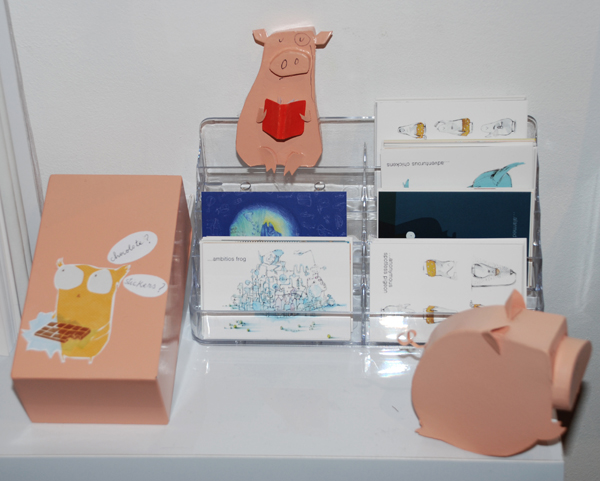
Hello! Did you know society6 has FREE shipping thru Sunday, worldwide? So if you fancy getting a polar bear cowboy iPhone skin or a scientist frog laptop skin, now is the time to order it :)
There are even Pigeon T-Shirts and pullovers. Classy, right?


16.8.11



One day...
I drew a chair.

Then I drew a bored panda on the chair.

After that I drew the chair. Again. From a different angle. (I know, how exciting, right?)

Then I drew the panda. Again. From a different angle.

I must have a wild imagination.
12.8.11
The Pig is waiting
Hello.
There are things you might not be aware of. Perhaps you think such a situation is highly unlikely, but what if it's true? For instance, did you know there is a rumor about a possible new etsy shop where me and the nerd here will sell art…and stuff?
Well if you don't want to miss out on the latest news about art and… stuff, follow us on our new Facebook fan page. Like Churchill. Soon he will be famous and I'm pretty certain you would like to brag about having met him before he became legendary.
The Pig is waiting.

6.8.11
Photography
These were my first two options. From the series "I see you like to chew".


Then I realized they might not be the most 'professional" pick… Why are goats never good enough for one's portfolio? It's beyond me… Therefore you can check out here my other boring picks.
27.7.11


8.7.11

17.6.11
Apple
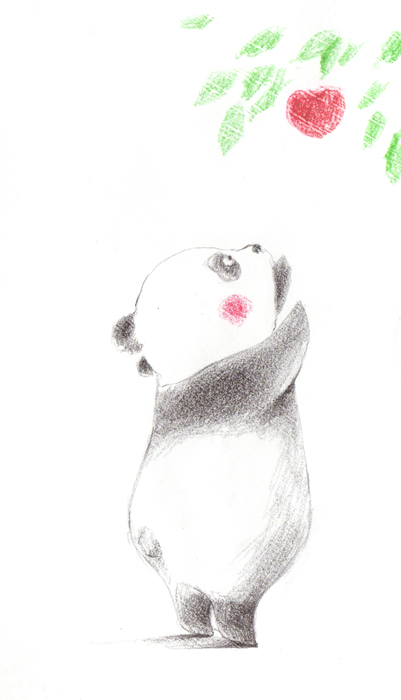
After being awfully ashamed by my last post, El Bobo decided to go on a diet. He no longer responds to El Croissanto.
16.6.11

14.6.11

11.6.11
El Bobo 2. Croque Monsieur

8.6.11
El Bobo

Bobo is a happy fellow with a great passion for the food industry. In real life he is actually skinny (and, as a matter of fact, human). But you know how Facebook never lies about your friends and google never lies about your health… well, my sketchbook doesn't lie either: this is how El Bobo* should look like.
*also known as El Croissanto.
6.6.11

4.6.11

3.6.11
monkeys and me

I made this in printmaking class in college, and it wasn't a success at all. Now I quite like it.
Or perhaps I'm being nostalgic.
Or perhaps I'm being nostalgic.
1.6.11

31.5.11
How to draw baby goats
1. Go to a farm


You have to find some real goats. Fur and everything.
Do not wear your favorite purse. It will be chewed.
Be prepared to socialize. Kids can be very playful, but unless you are a rockstar or a politician, crowds can be intimidating. (100 baby goats at the farm in the pictures!)
2. Draw realistically


Remember when you believed you are going to be a graphic designer and you didn't predict any goat encounters in your future? Forget that nonsense. Every artists needs to draw a goat in their lifetime. That's how you build a success story.
3. Develop a whimsical character

Now that you have become a goat connoisseur, it is time to develop a character for a potential story.
Quite the most difficult part of the process. Unless you have already spent hours in the cold (+rain) drawing realistically. Or you got attacked by a bear while drawing. Or you saw Anthony Browne and had no idea he is famous.
Right… drawing whimsically. Frankly, I have no idea how you do that. I am trying to make sense of it myself, with each drawing. So you'll have to figure it out yourself. It's just you and the goat now.
30.5.11


25.5.11
Panda 1. Panda 2

For a new project I've been trying to make my two different characters actually look different. Even though they are pandas. And as we know, pandas tend to look identical. Tom was right. It is hard to make characters different based on their own features, not their outfits or accessories.
23.5.11

21.4.11

19.4.11

15.4.11

8.4.11

21.3.11
Walt Disney is a genius
He is not only the impersonation of the classic American self-made man, but also the cryogenized proof of how one can deeply and irreversibly influences the culture.
Various authors proliferated the same stories in almost all the accounts of his life, some disregarding original sources of information, some adding interesting details. For example, he presumably held a notebook where he wrote ideas that came to him in the middle of the night. However (propagandist) that might sound, it would make perfect sense to me. After all, he was a creative person- an innovator and a visionary, employing art and science, creativity and technology in the manufacturing a fantasy that would come to worth billions.
His success story was also influenced by the cultural context and circumstances. The manufacturing of the fantasy world begun during the time America was recovering from the Great Depression. Snow White, the first animated film, didn’t only impressed with innovation and quality, but also because it offered the possibility of having dreams- even if they were basically the same dreams-, and mastering the future. It offered an alternative world, widely and subliminally accepted.
We might regard people’s refuge in fantasy with sarcasm or, at least, disbelief, but looking at today’s society, we can observe the same phenomenon taking place. Think about how many vampire or blue man stories you have seen on television, read books on, or simply seen advertisements about. It is indeed a different kind of fantasy than the one made commonplace by Disney, but it feeds on the same need for an alternative reality. And what is Disney but a clean alternative of Hollywood with higher ethical standards, as Michael Eisner, the former CEO of Disney stated.
What makes the Disney phenomenon particular though it is the interesting process that shaped the world he created into a product, and later on how the product itself shaped the world. This process is dominated by Disney’s contemporary social and cultural circumstances and his view for the future. This interrelation between his ideology and the context is the framework in which the rendering machine operates. In essence, it functions by taking folk tales or historical events and shaping them according to an” identifiable universe of semantic meanings” (Michael Reel), which creates a recognizable Disney product that eventually comes to enforce a culture and becomes and agent of education, spreading its influences on all areas, including art and, evidently, picture books, all with the support of media ad strong corporatist tactics.
My study will analyze each step of the process and discuss its consequences relevant for the contemporary practice. A first interesting observation is that each step of the process so called disneyfication is basically a process in itself.
First of all is the far from arbitrary -selection process. Disney’s sources have been primarily folk tales and historic events or characters. During history, folk tales ascended correspondingly to “violent and progressive shifts in society and celebrated individualism, subjectivity, and reflection. It featured the narrative voice of the educated author and publisher over communal voices and set new guidelines for freedom of speech and expression” (Zipes) and have been perpetuated from generation to generation by telling and retelling, “losing here a detail, gaining there a new hero, disintegrating gradually in outline, but being re-created occasionally by some narrator”, as Joseph Campbell says. He continues by describing them as “an art on which the whole community of mankind has worked” and “Clearly… no toy for children”. C.S. Lewis makes the same argument when he says, “Many children don’t like them [fairytale] and many adults do”.
Victorians dramatically changed the stories and adapted them for your readers. The custom perpetuated: stories were reshaped in accordance with the message that the storytellers want to communicate, the norms of the prevailing culture, and the specifics of the audience.
What Disney did was seemingly the same: he chose specific stories that allowed him rendering according to his individualistic ideology, according to the general culture, and the specifics of its audience. And, as the worldview those days was shifting between modern and postmodern, so was his tendency of combining the virtual with the certainty, the imaginary and the real. He created a whole new world by interweaving the postmodern techniques of parody and pastiche. He parodied the folklore, the history, and ultimately the world. Everything was a heritage that could be edited, re-evaluated, but not entirely how most postmodernist would do, - that is, regarding the past with a certain respect- but, as Richard Schickel says, by coming “always as conqueror, never as a servant” in the attempt to shape collective memory.
Is Disney following the path of revising the stories according to the culture, or did he use infamous forms of editing that lead to what some call “adaptation decay”? He has certainly rephrased the literary patrimony by adding elements (a cause for that might be the fact that he actually needed to stretch a 6 pages story to a full length film), removing unpleasant historical facts and undesirable elements- a process called by some “sanitizing literature”. Nevertheless, contemporizing, political correctness and the censorship of certain elements do not damage the story itself, as long as a balance is enforced, but what Disney did was far beyond that. He completely changed the purpose of the fairytale, transforming it from a story that was supposed to prepare the young for adulthood into mere entertainment, in the same way postmodernism transformed the knower into consumer of knowledge.
Disney’s monopoly encourages a psychological detachment form the real world, which he replaces with a sanitized, safe and entertaining replica. He reframed the real world by merchandising and packaging it into commercial clichés that can be easily managed and staged. Furthermore, as Baudrillard argues, Disney integrated the real world in his synthetic universe: “We are no longer in a society of spectacle, which itself has become a spectacular concept. It is no longer the contagion of spectacle that alters reality, but rather the contagion of virtuality that erases the spectacle an enterprise of radical deterrence of the world from the inside and no longer from outside, similar to the quasi-nostalgic universe of capitalistic reality today.” Not only does Disney erase the real, but also he also homogenizes the cultures by juxtaposing them in a distinct scenario and completely obliterates the notion of time in a “single atemporal virtuality”. As Baudrillard says, “Disney realizes de facto such an atemporal utopia by producing all the events, past or future, on simultaneous screens, and by inexorably mixing all the sequences as they would or will appear to a different civilization than ours. But it is already ours. It is more and more difficult for us to imagine the real, History, the depth of time, or three-dimensional space, just as before it was difficult, from our real world perspective, to imagine a virtual universe or the fourth dimension [la quatrieme dimension].”
In this way Disney moved from being simply an alternative to other forms of story telling to dominating the entire culture and gained corporate reach and political power over multiple levels of children’s culture. Disney created a global market for children and turned them into consumers by blurring the line between consumption and institution. Giroux states that is impossible for children to distinguish these societal practices of consumption and that makes their exploitations as consumers rather easy. That being the case, stories are selected according to their potential in interpreting their content and characters into products which later come to standardize play and deprive children from naturally exploring and making sense of the world, due to the fact that the means of explorations are imposed on them. Later on, they are forced to define themselves by brands.
As aforementioned, Disney is not just an alternative. Some might say that Disney has made the proliferation of folk stories possible, but that remains only an assumption. Some believe the opposite: Disney has impeded the natural evolution of folk tale. Picture books are now seen as related merchandise. The actual damage produce by Disney is adapting literature according to the vision of globalization, postmodernizing and consumerism.
Even at a stylistic level, it is hard to compete with the absolute saturation of the marketplace. But there are still alternatives and maybe the Disney monopoly will function as an impulse for creating original work that would not be stylistically valuable, but would also acknowledge its educational purpose and pursue to affirming and developing children’s personality and shaping they world-view accordingly.
Disney is a genius. His work, “is capitalism, it is a work of genius; as culture, it is mostly a horror.” (Richard Schickel)
20.3.11

Subscribe to:
Posts (Atom)
